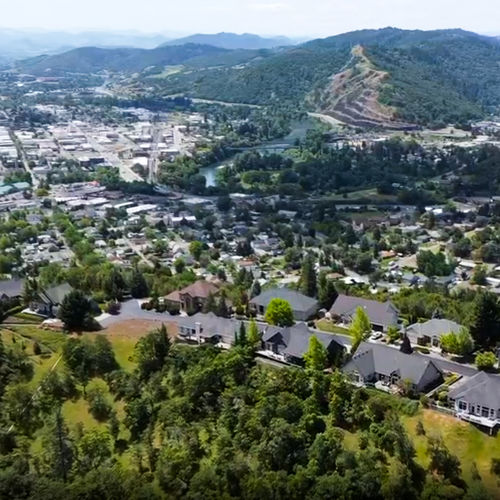



The biggest downsides of living in Roseburg, Oregon are about six months of gray skies from November to May, wildfire smoke in late August and September, a 70 mile drive to Eugene for specialists and flights, a small town that closes early, and rural homes that cost more to maintain than most buyers expect.
I’m a broker here, and every year I help people move in from California, Arizona, Portland, and Seattle. Most of them love it. Some should have stayed put. Below is who each of these five things wrecks, and who it won’t bother at all.
Would you rather hear it from me directly? In about 10 minutes I cover all five, including what clients told me after their first winter here.
Is Roseburg really that gray in the winter?
Yes. From about November to May, the sky over Roseburg is flat and gray most days. It isn’t dramatic weather, and there isn’t much snow. It’s overcast day after day. In December and January I’ve seen stretches of 10 to 12 days in a row without a single shadow on the ground.
NOAA doesn’t track Roseburg directly, but we sit between two cities it does. NOAA puts Medford at 169 cloudy days a year and Eugene at 209. That’s noticeably fewer than Portland or Seattle, but if you’re coming from California or Arizona, it flips everything you’re used to.
I sold a home to a couple from Redding, California who moved in during the summer. They loved the house, the price, and the summers. The next February, the wife called me and said she felt like she was living in a Tupperware container. By June they were happy again, but they hadn’t prepared for that first winter at all.
Who it bothers: Anyone who struggles with seasonal depression, which is a mood slump tied to short, dark winter days. If winter already gets to you where you live now, this could be your deal breaker.
Who it doesn’t: People who like weather with some personality. You get green moss on everything, rivers running full, and no lawn watering from October to June.
How bad is wildfire smoke in Roseburg?
Smoke season in Roseburg usually runs from late August through September. Smoke season means the weeks when smoke from wildfires in Oregon or Northern California drifts into the Umpqua Valley. Some years it’s one hazy weekend. Other years it’s two or three weeks of bad air where you keep the windows shut and cancel plans.
How bad it gets depends on where the fires are and which way the wind blows. Air quality is measured on the EPA’s Air Quality Index, or AQI, where anything over 100 is unhealthy for sensitive groups. Oregon DEQ’s annual air quality reports show Roseburg with 10 days over AQI 100 in 2020, the year of the Archie Creek fire, 5 in 2021, 8 in 2022, 9 in 2023, and zero in 2024, even though 2024 was a record fire season statewide. The monitor missed some days in 2022 and 2023, so those two counts may run low.
I’ve listed houses in August where the mountains behind the house were completely invisible. Listing photos I took in July can look like a different property by September.
Who it bothers: Anyone with asthma, lung problems, or heart conditions. If you’re 60 and have breathing issues, know this before you write an offer. It also hits people who planned retirement around hiking the North Umpqua trails or camping near Diamond Lake, since fires can close campgrounds right at the end of summer.
Who it doesn’t: Indoor people, and anyone coming from Sacramento or the Bay Area. You’ve already lived through worse.
How far is Roseburg from Eugene, and why does that matter?
Eugene is about 70 miles north of Roseburg on Interstate 5, roughly an hour and 15 minutes each way. That drive matters because Eugene is where you go for medical specialists, the airport, and specialty shopping. Roseburg has Mercy Medical Center and good general care, but it doesn’t have depth.
If you need a cardiologist, an oncologist, or certain surgeons, you’re driving to Eugene. I fly out of Eugene every time. Anything I can’t get at Costco or Fred Meyer, I either buy in Eugene or have delivered.
A buyer of mine moved here from the Bay Area. Then his wife started a treatment plan that meant driving to Eugene once a week. That drive got a lot less scenic real quick.
| Where you live | Drive to Eugene | Good fit for |
|---|---|---|
| Roseburg | About 1 hour 15 minutes | People who go to Eugene a few times a year |
| Sutherlin | About 1 hour | People who want Roseburg prices a bit closer to Eugene |
| Drain, Yoncalla, Elkton | About 40 minutes | People who commute to Eugene or have weekly appointments |
Drive times above are my own, from driving these routes regularly. Drain, Yoncalla, and Elkton are still in Douglas County, and I know plenty of people who work in Eugene and bought there because Eugene prices got out of reach.
Who it bothers: Anyone with weekly appointments in Eugene, or anyone who flies more than once a month.
Who it doesn’t: Healthy retirees who travel once or twice a year and don’t mind ordering online.
Is Roseburg too small for some people?
For some, yes. Roseburg is a small town that shuts down early. Dinner options are limited, most restaurants close by 10 p.m., and there’s no real nightlife. You’ll also run into your dentist at the grocery store, so privacy works differently here than in a big city.
Concerts, big events, and a real variety of restaurants mean a trip to Eugene or Portland. I save my good restaurant meals for those trips, and I haven’t missed many.
I run into someone I know almost every time I’m at the grocery store. If you had a rough week, three people will ask you about it.
This one splits people about 50/50. If you liked being anonymous in the Bay Area with 40 restaurants 10 minutes away, a Roseburg winter can feel like a prison. But half my clients moved here because they wanted the checker to know their name. Same town, opposite reactions.
What does it really cost to own a rural home near Roseburg?
More than most out of state buyers budget for. Homes outside Roseburg city limits usually run on a private well, a septic system, propane, and a gravel driveway you maintain yourself. Add windstorm power outages that can last a day or two, and the real cost of that 5 acre property climbs fast.
I watch buyers see 5 acres and a shop listed around $500,000, whether it’s out toward Glide, Oakland, or the hills around Winston and Myrtle Creek, and think they found a steal. Then the bills show up:
- Well pump: Plan on about $1,500 to $4,000 installed for a replacement, according to Aqua Pro Pump Service, the closest Oregon well contractor that publishes prices. I’ve seen them go out in year two.
- Septic pumping: Needed every few years. On my last few closings, sellers paid $400 to $800 for a pumping.
- Gravel: Your driveway is your job now. Cojo Asphalt, an Oregon supplier, puts a delivered dump truck load of about 10 to 14 yards at $250 to $750 or more. Around Roseburg, I’d budget $450 to $750 for a load of 3/4 minus, and more if you’re well out of town or up a steep drive.
- Generator: Most rural owners buy one after their first winter outage. Budget $12,000 to $18,000 for a 22kW propane whole house generator, fully installed. Portland installer Electric Avenue PNW prices a standard 22kW install at $11,500 to $13,000, and rural site work usually pushes it higher.
- Propane: Instead of natural gas, you’re filling a tank.
Then there are the deer. Buyers love seeing them in the yard during a showing. Then they plant a garden their first spring and feed the neighborhood herd all summer.
Who it bothers: Anyone who has never owned rural property and doesn’t want a maintenance hobby. My advice is simple: buy in town. City water and city sewer, problem solved.
Who it doesn’t: People who already know how to run a place, and a lot of newly retired folks who want a project to make their own.
Key takeaways
- Roseburg winters are gray more than snowy, from about November to May.
- Wildfire smoke usually arrives between late August and September, and the severity changes every year.
- Eugene, about 70 miles north on Interstate 5, is where you go for specialists and flights.
- Roseburg is small and quiet, which people either love or can’t stand.
- Rural homes come with a well, septic, propane, and outages. If that’s not you, buy in town.
If none of this scares you off, here’s what you get: a house that costs a fraction of what you sold, no traffic, the North Umpqua less than 30 minutes from your front door, and neighbors who show up when your truck won’t start. The people who thrive here knew what they were signing up for. The ones who regret it were sold a postcard.
Frequently asked questions
Is Roseburg, Oregon a good place to retire?
For the right person, yes. Roseburg works well for retirees who want lower home prices, no traffic, and quick access to the North Umpqua River. It works poorly for retirees who need weekly specialist care, since most specialists are in Eugene, about 70 miles north. Anyone with lung or heart problems should also weigh the late summer wildfire smoke.
Does it snow in Roseburg, Oregon?
Not much. Roseburg winters are gray and wet more than snowy, and the valley floor rarely holds snow for long. The bigger adjustment is the overcast sky that runs from about November to May. If you want snow, Diamond Lake and the Cascades east of town get plenty of it, and they make an easy day trip.
When is wildfire smoke season in Roseburg?
Wildfire smoke in Roseburg usually shows up between late August and September. How bad it gets depends on where fires are burning and which way the wind blows. Some years bring only a hazy weekend. Other years bring two or three weeks of poor air quality where you keep windows closed and move plans indoors.
What is the closest major airport to Roseburg?
Eugene Airport is the closest major commercial airport to Roseburg. It sits about 70 miles north on Interstate 5, which is roughly an hour and 15 minutes each way. I fly out of Eugene every time. If you fly more than once a month, factor that drive into where you buy.
Should I buy in town or in the country near Roseburg?
Buy in town unless you already know how to run a rural property. Homes inside city limits have city water and city sewer, so there is no well pump or septic system to maintain. Country homes offer land and views, but they come with wells, septic, propane, gravel driveways, and power outages that newcomers often underestimate.
Want the full picture before you decide?
I put together a free relocation guide that covers Roseburg and the towns around it: cost of living, neighborhoods, and the local service providers you’ll need. Grab the Douglas County relocation guide here and read it before you book your first trip.